News
Recent news and announcements.
Community-Based Development Plan
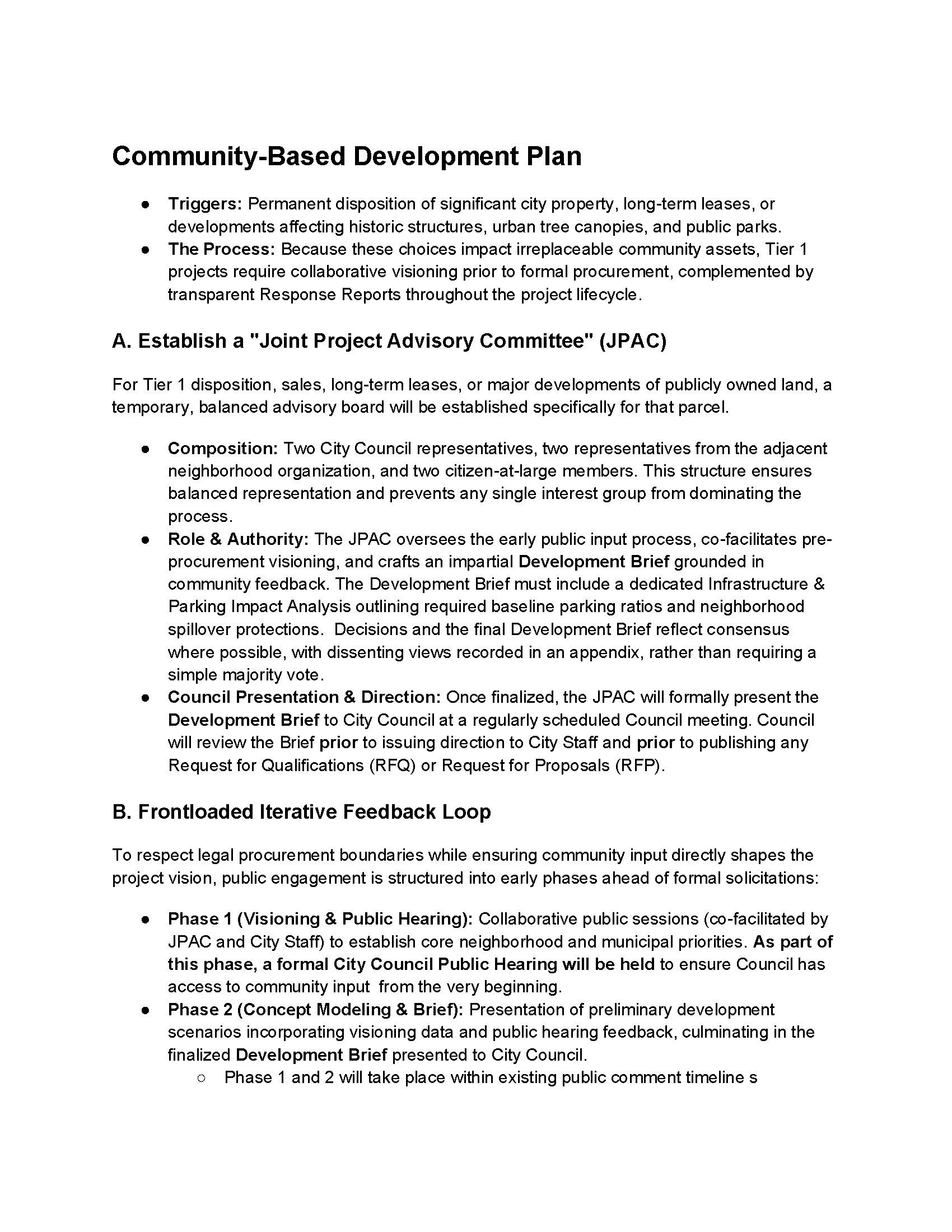
Community-Based Development Plan
· Triggers: Permanent disposition of significant city property, long-term leases, or developments affecting historic structures, urban tree canopies, and public parks.
· The Process: Because these choices impact irreplaceable community assets, Tier 1 projects require collaborative visioning prior to formal procurement, complemented by transparent Response Reports throughout the project lifecycle.
A. Establish a "Joint Project Advisory Committee" (JPAC)
For Tier 1 disposition, sales, long-term leases, or major developments of publicly owned land, a temporary, balanced advisory board will be established specifically for that parcel.
· Composition: Two City Council representatives, two representatives from the adjacent neighborhood organization, and two citizen-at-large members. This structure ensures balanced representation and prevents any single interest group from dominating the process.
· Role & Authority: The JPAC oversees the early public input process, co-facilitates pre-procurement visioning, and crafts an impartial Development Brief grounded in community feedback. The Development Brief must include a dedicated Infrastructure & Parking Impact Analysis outlining required baseline parking ratios and neighborhood spillover protections. Decisions and the final Development Brief reflect consensus where possible, with dissenting views recorded in an appendix, rather than requiring a simple majority vote.
· Council Presentation & Direction: Once finalized, the JPAC will formally present the Development Brief to City Council at a regularly scheduled Council meeting. Council will review the Brief prior to issuing direction to City Staff and prior to publishing any Request for Qualifications (RFQ) or Request for Proposals (RFP).
B. Frontloaded Iterative Feedback Loop
To respect legal procurement boundaries while ensuring community input directly shapes the project vision, public engagement is structured into early phases ahead of formal solicitations:
· Phase 1 (Visioning & Public Hearing): Collaborative public sessions (co-facilitated by JPAC and City Staff) to establish core neighborhood and municipal priorities. As part of this phase, a formal City Council Public Hearing will be held to ensure Council has access to community input from the very beginning.
· Phase 2 (Concept Modeling & Brief): Presentation of preliminary development scenarios incorporating visioning data and public hearing feedback, culminating in the finalized Development Brief presented to City Council.
o Phase 1 and 2 will take place within existing public comment timelines
· City Council Intent & Alignment Report: Prior to issuing an RFQ/RFP, City Council must issue a public report detailing the specific municipal goals sought through procurement (e.g., childcare facilities, affordable housing, or municipal operations).
o Alignment Requirement: If City Council’s targeted procurement goals differ from or exclude key priorities in the community’s Development Brief, this report must explicitly explain the policy, technical, or financial reasons for that departure before the solicitation is released.
C. Post-RFQ Accountability & Continued Engagement
Once formal procurement begins and a developer or vendor is selected through the RFQ/RFP process, public accountability continues through project execution:
· Selection & Justification Report: Upon conditional award to an RFQ/RFP respondent, the City and JPAC will publish a report detailing why the winning proposal was selected and how it aligns with the original Development Brief.
· Final Response Report: Prior to City Council’s final authorization of the development agreement, the City must publish a Response Report detailing how public feedback influenced the refined design. If a key community priority was omitted, clear technical or financial justification must be provided.
· Continued Engagement: Formal public comment periods will be held following the publication of both the Selection Report and the Final Response Report, with the JPAC remaining active in an advisory capacity through final project approval.